
When it comes to wasp nest removal, safety is the number one priority. Obviously, you don’t want to get stung, but you don’t want to get hurt falling off a ladder either, or falling over, when running away from a swarm of angry wasps! Some wasp nest removals could be considered by the confident DIY homeowner, but it really depends on the type of wasp. Certainly, if we’re talking about the dangerous European wasp, we would always suggest hiring a professional wasp exterminator.
Here’s how we approach was control and wasp nest removal at Termites VIC, Termite & Pest Control…
Native Australian Wasp Nest Removal
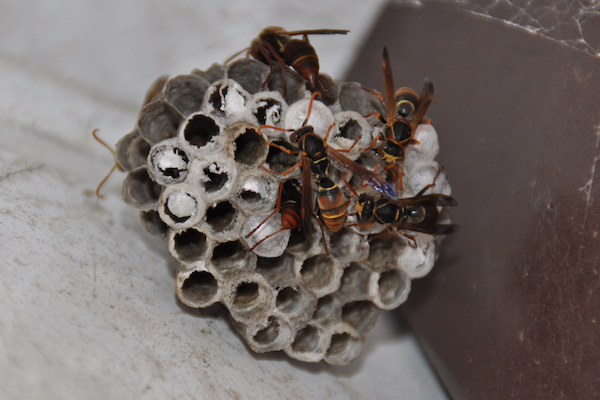
There are several species of native of Australian wasp. Most of native species build small nests of up to a few hundred individuals. These native wasps typically build their nests in sheltered areas around buildings (e.g. under eaves), on fencing and out-buildings, or under large leaves or branches. Our wasp treatment focuses on the nests on the buildings and on plants near the building and areas of human activity.
Most native paper wasp nests have an open construction – there is no protective covering over the nest – which means the wasps and the larval cells are all visible. This makes the nest relatively easy to destroy and remove. For these open native Australian paper wasp nests, we will spray them directly with insecticide. We may either spray using our general spray equipment or sometimes we use a specialised, high output wasp aerosol.
When we spray the nest, the wasps will die almost instantly. Any wasps not in the nest will either pick up insecticide when they return to the nest or desert the area when they realise the nest has been destroyed. These are sterile workers and cannot start a new nest. The nest can be physically knocked onto the ground using a pole (or broom), picked up and placed in a bag (wearing gloves) and placed in the bin.
European Wasp Nest Removal
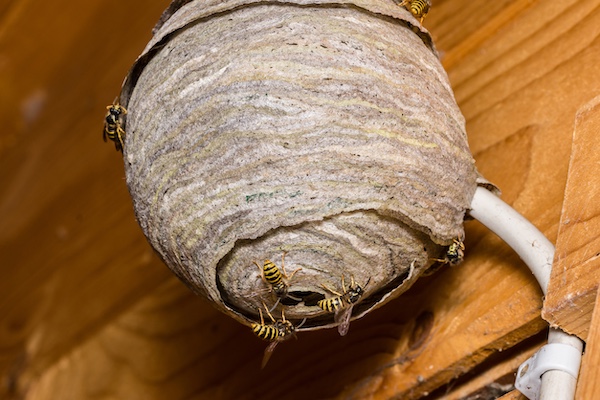
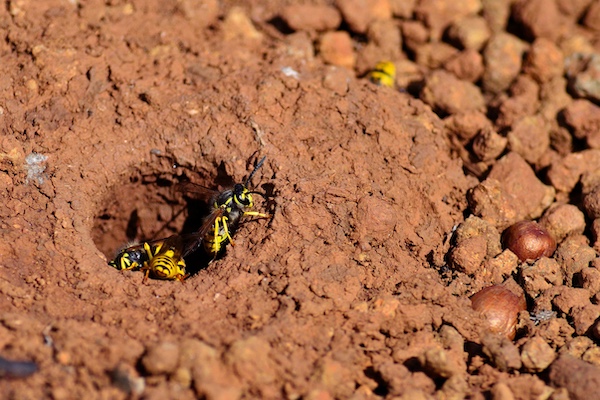
European wasp nest removal is a more involved process and safety precautions are essential. 80% of European wasp nests are actually underground, with only 20% above ground on buildings or plants. Of the nests on buildings, although some are visible, others can be in roof voids or wall cavities making access difficult. For these above ground nests, they almost always covered in a protective paper shroud which makes insecticide application difficult.
Although we prefer to carry out European wasp nest treatments later in the day when most of the wasps are back in the nest and they tend to be more relaxed, this is not always possible. The first step is to make sure people and pets are kept well clear of the treatment area. We then kit up wearing a bee suit, which also protects us against wasps.
For above ground nests, we need to be very accurate and apply insecticide directly into the entrance hole of the nest. Whilst we may use spray, typically we will blow insecticide powder into the nest. To do this from a safe distance and ensure we get product into the nest, we will often attach a length of tubing to the blower and insert into the nest.
We always use insecticide powder with underground nests, as there is no way of knowing the size and shape of the chamber, and powder blows into every crack and crevice. For in-ground nests, the entrances tend to be a bit larger, but we still need to be accurate and like to keep our distance, so we blow insecticide powder into the chamber using a length of tubing. The nest is typically destroyed in minutes.
In terms of actually removing the nest, we can only practically do this for nests on the outside of buildings or in roof voids. Removal of wasp nests in wall voids will need a builder to open up the wall for nest removal, before carrying out the necessary repairs. For wasp nests underground, we simply leave them in place, unless a customer requests us to dig it up.
Preventing wasps building their nests
It’s not possible to prevent wasps building their nests on plants, underground around the property or in roof voids. However, wasps won’t build their nests on surfaces sprayed with a residual insecticide. Our general pest spray, which includes spraying the outside of the building can prevent wasps building their nests under eaves for a period of months.
If you need to protect your family and pets from potential wasp attacks or need a wasp nest removed, give the expert wasp exterminators at Termites VIC Termite & Pest Control a call for a professional wasp control treatment.